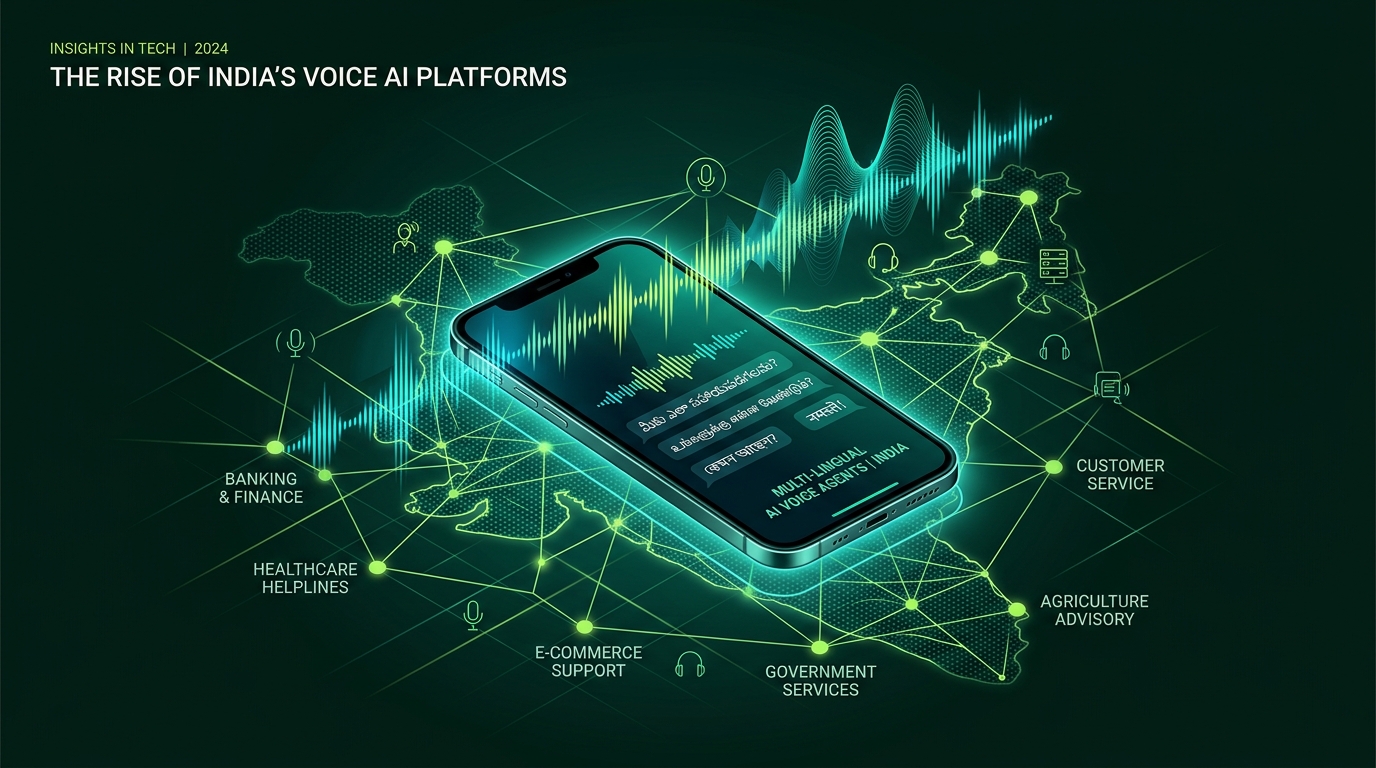
The 2026 Conversational Shift in Indian Telephony
Indian businesses have reached a tipping point in customer communications. For over two decades, Indian contact centers and local businesses relied on rigid keypad IVR menus ("Press 1 for English, Press 2 for Hindi") or outsourced human telecalling BPOs. Both models are breaking down under modern customer expectations:
- Dialer fatigue: Over 68% of Indian consumers hang up when forced through multi-tier DTMF menus.
- Speed-to-lead latency: Inbound inquiries from WhatsApp, Meta Ads, and web portals go cold if not engaged within 5 minutes.
- The Indic linguistic challenge: Urban and regional callers in India rarely speak clean textbook English or pure Hindi. They mix languages mid-sentence—shifting naturally between Malayalam and English (Manglish), Hindi and English (Hinglish), or Tamil and English (Tanglish).
In 2026, autonomous AI voice agents have matured into production-grade systems capable of holding natural, sub-second phone conversations over Indian carrier networks. However, not all platforms are engineered for the same operational requirements. Some require enterprise contracts and six-week implementation cycles; others are raw APIs built strictly for developers; and a few provide self-serve visual builders designed for immediate deployment.
This guide provides a comprehensive, unbiased evaluation of the 12 leading AI voice agent platforms in India for 2026, comparing their underlying architecture, real-world pricing models, regional language capabilities, conversational latency, and ideal use cases.
12 Indian Voice AI Platforms: Head-to-Head Comparison
The table below summarizes the core operational metrics across all 12 platforms:
| Platform | Primary Architecture | Indic Language & Dialect Fidelity | Pricing Model | Latency (P95) | Telephony Setup | Best For |
|---|---|---|---|---|---|---|
| Binate AI | Visual Self-Serve Builder (No-code / Low-code) | Native Malayalam, Tamil, Telugu, Kannada + Hindi & English; natural code-switching | Transparent Pay-As-You-Go; free starter builder; no lock-in | < 400ms | Plug-and-play Indian DIDs (+91) & SIP forwarding | South Indian SMEs, clinics, D2C brands, and local services |
| Bolna AI | Developer-First Composable API | 10+ Indic languages; modular ASR/TTS model switching | Approx. $0.06/min (₹5.52/min) + carrier costs; BYO-keys supported | 300ms–500ms | External SIP / Twilio / Plivo / Exotel | Engineering teams building custom voice bots & workflows |
| Caller Digital | Turnkey Mid-Market Platform | Hindi, Hinglish + 13 regional languages; DLT/DPDP compliant | Outcome-based (from ₹8/outcome) or tiered (₹4–₹12/min) | 500ms–800ms | Integrated Indian telephony (Exotel/Knowlarity) | D2C brands (COD confirmation) & financial services |
| Gnani.ai | Proprietary Enterprise Speech Stack | 14+ Indic languages; proprietary models (Prisma STT, Timbre TTS) | Enterprise annual contract; custom implementation fee | < 300ms (models), approx. 800ms pipeline | Enterprise PBX, SIP trunking, on-prem air-gapped | Tier-1 BFSI, national banks, telecom carriers |
| Yellow.ai | Enterprise Omnichannel CX Suite | 20+ Indic languages & dialects; Nexus Vox / VoiceX engine | Enterprise annual licensing (sales-gated voice tier) | 400ms–600ms | Enterprise carrier connections & cloud contact centers | Global & Indian Fortune 500 enterprises |
| Mihup | Contact Center Virtual Agents & Analytics | Eastern & Northern Indic focus (Bengali, Hindi, Hinglish) | Blended ₹6–₹25/min; seat-based analytics licensing | 600ms–900ms | Telecom trunking & call center PBX integration | Large BPOs, automotive in-cabin voice, enterprise support |
| Rootle.ai | Conversational OS for Contact Centers | 22+ Indian languages; fluid multi-lingual code-switching | Outcome-driven / volume tiers for contact centers | < 1,000ms | Integrated carrier routing | Fintech collections, loan recovery, BPO call displacement |
| SquadStack AI | Hybrid AI + Human-in-the-Loop Calling | Indian English, Hindi, and select commercial dialects | Per-connected-second or revenue-outcome realized | Hybrid handoff | Managed telecom outbound calling network | High-ticket real estate, ed-tech sales, BFSI lead qualification |
| DialNexa | Telecom-First Concurrency Engine | Hindi, Kannada, Telugu, regional business dialects | Concurrency & volume-based infrastructure pricing | 600ms–800ms | Indian PSTN / Zoho Bigin / local carrier routing | Indian outbound calling operations needing high concurrency |
| Skit.ai | Voice Automation for Debt Recovery | Hindi, regional Indian languages, US English, Spanish | Custom enterprise recovery fees & resolution pricing | Sub-second | Enterprise SIP trunks & collection dialers | Retail banks, micro-finance institutions, NBFC collections |
| HuskyVoice.AI | Front-Desk Receptionist for SMBs | English, Hindi, Hinglish + regional appointment flows | Monthly subscription tiers with bundled minute allocations | 500ms–800ms | Cloud forwarding / WhatsApp bridge | Independent clinics, diagnostic labs, regional real estate |
| Vapi / Retell AI | Composable Global Voice Orchestrators | Requires custom Indic adapters (e.g., Sarvam AI / ElevenLabs) | Base platform fee ($0.05/min) + models + telecom = ₹8–₹14/min | 400ms–700ms | Custom SIP trunking via Exotel or Tata Tele | Full-stack engineering teams wanting total pipeline control |
In-Depth Analysis of the 12 Platforms
1. Binate AI: Best for South Indian Regional Depth & Self-Serve Speed
Binate AI is engineered to solve the acute regional language gap in Indian voice automation. While the majority of Indian voice tools are trained primarily on Hindi and northern accents, Binate specializes in native South Indian languages—with industry-leading acoustic fidelity in Malayalam, Tamil, Telugu, and Kannada, alongside Hindi and Indian English.
Unlike legacy enterprise suites that enforce lengthy sales cycles, Binate provides a completely self-serve browser builder. Non-technical business owners, clinic administrators, and marketing managers can configure an agent prompt, connect a phone number, test live in their browser, and start taking calls in under 10 minutes.
- Indic Language Capability: Exceptional phonetic precision in Malayalam and South Indian dialects (handling Travancore, Central, and Malabar accents). Natively decodes colloquial code-switching (Manglish, Tanglish, Hinglish) without dropped turns.
- Conversational Latency: Sub-400ms round-trip latency, creating a natural interruption-aware conversation loop.
- Pricing & Transparency: Self-serve pay-as-you-go pricing with a free tier to build and test. No upfront implementation retainers or hidden seat licenses.
- Key Integrations: Native Indian virtual numbers (+91), SIP call forwarding from existing landlines, automated WhatsApp appointment token dispatch, and two-way CRM webhooks.
- Ideal For: Healthcare clinics, diagnostic labs, D2C e-commerce brands, educational admissions, and regional service businesses across Kerala, Tamil Nadu, Karnataka, and Andhra Pradesh.
Hands-on Test: You can configure and test a live AI agent in Malayalam or English directly in your browser using the Binate Voice AI Builder.
2. Bolna AI: Best for Developer-First Composable Workflows
Bolna AI is an open-source and API-first voice agent platform that secured $6.3M in seed funding led by General Catalyst. Bolna provides developers with a modular orchestration layer that lets them swap Speech-to-Text (ASR), Large Language Models (LLMs), and Text-to-Speech (TTS) providers on the fly.
- Indic Language Capability: Supports 10+ Indian languages and handles Hindi-English code-switching effectively through configurable model pipelines.
- Conversational Latency: Typically 300ms–500ms, depending on the specific combination of underlying models (e.g., Deepgram vs. Whisper vs. Cartesia).
- Pricing Structure: Usage-based starting at approx. $0.06 per minute (₹5.52/min) using managed models, or $0.02/min platform fee when using your own API keys (BYOK). Telecom minutes via Exotel/Twilio are billed separately.
- Limitations: Requires dedicated software engineers to configure webhooks, manage telephony SIP trunks, and handle production state management. Not suitable for non-technical teams looking for turnkey deployment.
- Ideal For: Tech startups, software engineering teams, and developers building bespoke voice bots for surveys, recruitment screening, and product integrations.
3. Caller Digital: Best for D2C E-Commerce & Outcome-Based Campaigns
Caller Digital focuses heavily on performance-oriented voice calling for the Indian market, positioning its pricing around business outcomes (such as verified Cash-on-Delivery orders) rather than raw minutes alone.
- Indic Language Capability: Supports Hindi, Hinglish, and 13+ regional languages, trained on conversational sales and customer verification datasets.
- Conversational Latency: 500ms–800ms over standard Indian carrier networks.
- Pricing Structure: Offers outcome-based pricing starting from roughly ₹8 per completed outcome (e.g., successful COD confirmation). For general calling, blended rates range from ₹4 to ₹12 per minute depending on volume and carrier routing.
- Limitations: Focuses predominantly on outbound campaigns and standardized transaction verifications; less flexible for complex multi-turn medical triage or bespoke appointment scheduling.
- Ideal For: Direct-to-Consumer (D2C) brands looking to eliminate RTO (Return-to-Origin) losses, logistics providers, and retail NBFCs running automated reminders.
4. Gnani.ai: Best for High-Volume Enterprise BFSI & On-Premises Deployments
Headquartered in Bengaluru and backed by Samsung Ventures, Gnani.ai is one of India's veteran conversational AI companies. Gnani operates a proprietary, full-stack speech architecture—including its own ASR (Prisma), TTS (Timbre), and conversational models (Aion)—bypassing third-party US model dependencies.
- Indic Language Capability: Deep multi-dialect coverage across 14+ Indic languages, trained on millions of hours of 8kHz noisy Indian telephonic audio.
- Conversational Latency: Model response times under 250ms, with complete pipeline latency around 800ms.
- Pricing Structure: Custom enterprise pricing only. Requires enterprise contracts, multi-week implementation scoping, and significant annual commitments.
- Key Differentiator: Offers certified on-premise and air-gapped private cloud deployments, making it compliant with strict Reserve Bank of India (RBI) data localization mandates.
- Ideal For: Large public and private sector banks, national insurance providers, telecom operators, and government institutions.
5. Yellow.ai: Best for Global Enterprises Replacing Legacy Contact Center Suites
Yellow.ai is a multinational conversational CX platform with a major presence in India. Its VoiceX and Nexus Vox architecture provides dynamic voice automation natively integrated into its omnichannel customer service ecosystem (chatbots, WhatsApp bots, and ticketing).
- Indic Language Capability: Covers 20+ Indian languages and regional dialects, alongside over 130 global languages.
- Conversational Latency: Advertised sub-400ms latency on dedicated enterprise infrastructure.
- Pricing Structure: Enterprise quotation model. While Yellow.ai offers a self-serve tier for text chatbots, advanced voice AI features are gated behind enterprise tiers with high minimum spend thresholds.
- Limitations: Significant platform overhead and steep learning curve for businesses that only need phone call automation without a massive omnichannel helpdesk.
- Ideal For: Large multinational enterprises, global airlines, and conglomerate customer support teams looking for a single vendor for voice, chat, and email tickets.
6. Mihup: Best for Contact Center Speech Analytics & Regional Inbound
Kolkata-born Mihup specializes in voice technology for Indian enterprise contact centers and automotive manufacturers (powering in-car voice assistants for brands like Tata Motors).
- Indic Language Capability: Particularly strong in Eastern and Northern Indian languages (Bengali, Hindi, Bihari dialects, Hinglish), with industry-leading word error rates (WER) on low-bandwidth 8kHz telephone connections.
- Conversational Latency: 600ms–900ms end-to-end.
- Pricing Structure: Voicebot pricing ranges from ₹6 to ₹25 per blended minute depending on telephony integration; speech analytics is priced at ₹2,000–₹9,500 per human agent per month.
- Limitations: Tailored primarily for enterprise BPOs and large-scale call centers; lacks self-serve onboarding for smaller businesses.
- Ideal For: Large contact center BPOs, automotive original equipment manufacturers (OEMs), and regional telecom helpdesks.
7. Rootle.ai: Best for Deterministic Collections & Call Center Automation
Rootle.ai is an India-focused conversational AI operating system designed to handle structured inbound support, recruitment screening, and debt collection calls.
- Indic Language Capability: 22+ Indian languages with strong contextual parsing of numbers, dates, and financial amounts spoken in regional phrasing (lakhs, crores, dates).
- Conversational Latency: Sub-1,000ms response times optimized for conversational realism.
- Pricing Structure: Tiered volume-based pricing aligned with contact center cost-reduction targets.
- Limitations: Emphasizes deterministic and structured call flows; less open-ended conversational flexibility for exploratory advisory calls.
- Ideal For: Financial institutions, debt recovery agencies, and business process outsourcing (BPO) firms looking to reduce agent headcount on repetitive verification calls.
8. SquadStack AI: Best for High-Ticket Lead Follow-Up with Human Fallback
SquadStack takes a distinct hybrid approach to telecalling in India. Instead of relying solely on autonomous voice bots, SquadStack combines AI calling agents with a vetted, distributed human telecalling workforce.
- Indic Language Capability: Native Indian English, Hindi, and major commercial languages.
- Conversational Latency: Leverages AI for initial lead scoring and screening, transitioning seamlessly to live human agents when complex negotiation or objection handling is required.
- Pricing Structure: Performance-based and usage-based pricing, charging for connected conversational seconds or tying fees to sales milestones achieved.
- Limitations: Higher cost per interaction compared to pure-play autonomous voice bots; not designed for automated 24/7 inbound clinic reception or technical customer support.
- Ideal For: Real estate developers, ed-tech admissions, luxury automotive sales, and high-ticket financial advisory services where human closing is mandatory.
9. DialNexa: Best for High-Concurrency Telecom Outbound Operations
DialNexa is an infrastructure-first voice platform designed specifically to solve the high-concurrency bottlenecks common in Indian outbound calling campaigns.
- Indic Language Capability: Strong regional language handling across Hindi, Kannada, Telugu, and English, with built-in noise suppression for noisy call environments.
- Conversational Latency: 600ms–800ms on enterprise SIP routes.
- Pricing Structure: Infrastructure and concurrency-slot pricing, making it predictable for operations making tens of thousands of calls daily.
- Key Features: Deep CRM integration with tools like Zoho Bigin and local Indian carrier routing compliance.
- Ideal For: Medium-to-large outbound telemarketing operations, event reminder campaigns, and high-frequency automated survey systems.
10. Skit.ai: Best for Banking & Collections Automation
Formerly known as Vernacular.ai, Skit.ai is one of the earliest Indian voice AI startups. In recent years, Skit has focused almost exclusively on automated debt collection, recovery cadences, and customer account servicing across India and North America.
- Indic Language Capability: Multi-lingual support across major Indian languages with strict compliance guardrails to prevent hallucinations during financial conversations.
- Conversational Latency: Sub-second response times.
- Pricing Structure: Enterprise and recovery-performance contracts.
- Key Features: Pre-built regulatory workflows complying with Indian banking guidelines (TRAI DLT, RBI collection rules, and calling time windows).
- Ideal For: Commercial banks, microfinance institutions, consumer lending apps, and third-party recovery agencies.
11. HuskyVoice.AI: Best for Local Front-Desk Receptionists
HuskyVoice.AI is tailored for small, local businesses seeking a reliable virtual receptionist to manage incoming customer calls, handle appointment bookings, and prevent missed business.
- Indic Language Capability: Handles English, Hindi, and Hinglish with conversational code-switching, with workflows centered on calendar scheduling.
- Conversational Latency: 500ms–800ms.
- Pricing Structure: Monthly SaaS subscriptions with bundled minute allocations, offering an accessible entry point for single-location businesses.
- Key Features: Integrations with Google Calendar, WhatsApp notifications, and webhook triggers for small business CRMs.
- Limitations: Limited out-of-the-box depth for South Indian languages (such as Malayalam and Tamil dialects); designed primarily for single-location setups rather than enterprise call volume.
- Ideal For: Dental clinics, aesthetic centers, independent real estate agents, and hospitality front desks.
12. Composable Stacks (Vapi / Retell AI + Exotel + Sarvam AI): Best for Custom Engineering
For engineering organizations that prefer total architectural control, building a custom stack using developer frameworks like Vapi or Retell AI paired with Indian telecom providers (Exotel or Tata Tele) and sovereign Indic AI models (Sarvam AI) has become a popular route.
- How the Stack Works:
- Orchestration Layer: Vapi or Retell AI manages WebSocket streaming, turn-taking, and interruption logic ($0.05–$0.055/min).
- Indic AI Layer: Sarvam AI models (Saaras for speech-to-text, Sarvam-105B for reasoning, Bulbul for speech synthesis) handle Indian phonetics (approx. ₹3.15–₹3.50/min).
- Telecom Layer: An Indian cloud telephony provider like Exotel provides the +91 Virtual Number and SIP trunking (approx. ₹0.80–₹1.50/min).
- Total Cost of Ownership: Billed across three separate vendor invoices, landing at ₹8.00 to ₹14.00+ per blended minute, excluding engineer maintenance costs.
- Latency Profile: 400ms–700ms under optimal network conditions, though multi-vendor API routing can introduce occasional jitter over mobile carrier networks.
- Limitations: Requires ongoing engineering maintenance, custom proxy middleware to connect non-native APIs, and separate vendor contracts with no unified SLA.
- Ideal For: Tech companies with dedicated AI infrastructure engineers who require 100% custom pipeline logic.
The Total Cost of Ownership (TCO) in India: Uncovering Hidden Telecom Costs
When evaluating voice AI platforms in India, looking only at the advertised headline platform price can be misleading. A true Total Cost of Ownership (TCO) model must account for four distinct operational layers:
| Cost Layer | Typical Industry Rate | What It Covers |
|---|---|---|
| 1. Platform & Orchestration | ₹1.50 – ₹5.00 / min | Speech streaming, turn-taking, interruption handling, and dashboard analytics |
| 2. AI Model Inference | ₹1.50 – ₹4.00 / min | Speech-to-Text (ASR) + LLM reasoning + Text-to-Speech (TTS) synthesis |
| 3. Telecom Carrier (SIP / PSTN) | ₹0.70 – ₹1.50 / min | Inbound/outbound call routing across Airtel, Jio, and Vi networks |
| 4. Fixed Infrastructure | Variable | Dedicated +91 DID rental, TRAI DLT registration, WhatsApp Cloud API tokens |
1. Unanswered and Failed Calls
In outbound sales or appointment reminder campaigns in India, typically 35% to 55% of dialed calls go unanswered, hit busy signals, or drop to voicemail. Some platforms bill for every dialed attempt that rings for more than 10 seconds, while others charge strictly for connected conversation time.
2. Regulatory & Compliance Overhead
Any enterprise making business calls in India must comply with TRAI (Telecom Regulatory Authority of India) DLT registration, maintain DND (Do-Not-Disturb) scrubbing, and adhere to calling time restrictions (9:00 AM to 9:00 PM for promotional calls). Platforms with native Indian telephony handle DLT headers automatically, saving weeks of carrier approvals.
3. Post-Call WhatsApp Dispatch
In the Indian market, a voice call is only half the battle. Customers expect immediate digital confirmation. Platforms like Binate AI that bundle automated WhatsApp Cloud API messaging (dispatching appointment tokens, clinic Google Maps locations, or payment links) eliminate the cost of maintaining separate third-party automation tools.
How to Choose the Right Platform: A 4-Step Decision Framework
To help you quickly navigate between developer stacks, enterprise contact center suites, and self-serve builders, follow this 4-step operational framework:
Step 1: Assess Your Engineering Capacity
- If you have in-house AI/backend engineers who want raw API composability: Choose Bolna AI for developer-friendly managed APIs, or assemble a Composable Stack (Vapi / Retell AI + Exotel + Sarvam AI) if you require custom WebSocket proxies and zero vendor lock-in.
- If you need an autonomous, turnkey system without writing code: Proceed to Step 2.
Step 2: Identify Your Calling Volume & Compliance Tier
- If you are a Tier-1 Bank, National Insurer, or Fortune 500 Enterprise: Choose Gnani.ai (for on-premise air-gapped security and strict RBI compliance) or Yellow.ai (for omnichannel contact center replacement). Be prepared for enterprise sales cycles, custom RFPs, and upfront implementation retainers.
- If you are an SMB, Clinic, Diagnostic Center, or Regional D2C Brand: Proceed to Step 3.
Step 3: Match Your Language & Dialect Requirements
- If your callers primarily speak South Indian languages (Malayalam, Tamil, Telugu, Kannada) or mix languages (Manglish, Tanglish): Choose Binate AI. It is the only self-serve platform purpose-built with sub-400ms acoustic models for southern regional accents and colloquial code-switching.
- If your primary volume is North Indian Hindi/Hinglish outbound sales: Evaluate Caller Digital (for COD verification) or DialNexa (for high-concurrency telephony).
Step 4: Compare Total Deployment Velocity
- Immediate Deployment (< 10 minutes): Sign up on Binate AI, configure your prompt, connect your number, and go live immediately.
- Multi-Week Scoping (4 to 8 weeks): Required for enterprise-grade suites like Gnani, Yellow.ai, and Skit.ai.
Choose Binate AI If:
- You operate in Kerala, Tamil Nadu, Karnataka, or Andhra Pradesh and require native, human-like voice agents in Malayalam, Tamil, Telugu, or Kannada without mechanical robotic accents.
- You want a self-serve visual platform where you can go live in under 10 minutes without paying tens of thousands of rupees in upfront consultant fees.
- You need end-to-end operational automation—including automated calendar booking, WhatsApp token delivery, and missed call recovery.
Choose Bolna AI If:
- You are a software engineering team looking to integrate voice agents into your existing Node.js or Python backend via clean REST APIs and WebSockets.
- You want the flexibility to test different LLMs and speech models programmatically.
Choose Gnani.ai or Yellow.ai If:
- You represent a large enterprise, scheduled commercial bank, or multinational company requiring on-premise air-gapped deployment, complex multi-month SAP/Oracle integrations, and formal enterprise SLAs.
Frequently Asked Questions
In 2026, the all-inclusive cost for a production AI voice agent in India typically ranges from ₹3.50 to ₹8.00 per minute on self-serve and pay-as-you-go platforms like Binate AI. Enterprise-grade suites with custom SLAs or unoptimized multi-vendor developer stacks can range between ₹10.00 and ₹18.00 per minute once telecom carrier fees are factored in.
Modern voice AI models utilize specialized acoustic datasets trained on natural Indian conversational audio. Rather than translating words into English first, platforms like Binate AI recognize phonetic patterns directly in mixed speech, allowing callers to switch naturally between Malayalam and English (Manglish) or Hindi and English (Hinglish) without conversational breakdowns.
No. Most modern platforms allow you to keep your existing landline or mobile numbers. You can simply set up conditional call forwarding (e.g., forward when busy, unanswered, or after business hours) to the dedicated virtual number provided by your voice AI platform.
For a phone call to feel natural and conversational, round-trip latency (time from when the human stops speaking to when the AI begins responding) must be under 600 milliseconds. Platforms like Binate AI achieve sub-400ms latency, preventing the awkward pauses and voice collisions that plague older voicebots.
Yes, provided businesses comply with TRAI telecom regulations. This includes registering your enterprise DLT entity for transactional calls, adhering to calling time windows (9 AM to 9 PM for promotional campaigns), scrubbing numbers against the National Customer Preference Register (NCPR/DND) for cold outreach, and ensuring customer data privacy in accordance with the Digital Personal Data Protection (DPDP) Act.
Modernize Your Inbound & Outbound Calling with Binate AI
Stop losing valuable customer inquiries to busy signals, unanswered calls, or robotic keypad menus. Build and test a custom conversational voice agent that speaks your customers' language with native regional fluency.
Explore our dedicated Malayalam Voice AI engine, see how clinics automate front-desk bookings with our Healthcare AI Receptionist, or calculate the hidden revenue cost of unanswered phone inquiries using the Missed Call Revenue Calculator.
Build Your AI Voice Agent in Under 10 Minutes
Experience sub-400ms conversational Voice AI with native South Indian language support. Test in your browser, connect your number, and start handling calls today with zero lock-in.
Get Started Free →Sources & Industry Benchmarks:
-
- TRAI (Telecom Regulatory Authority of India) Telemarketing Guidelines & DLT Mandate (2025–2026).
-
- Voice AI Market in India: Adoption, Latency & Regional Dialect Benchmark Study (2026).
-
- Binate Production Voice Telephony Analytics across 500+ Indian commercial deployments.