Your store looks healthy on top-line revenue. Orders flow, ads convert, the dashboard glows green. Then you open the P&L and the margin has quietly disappeared.
This is the story of Indian D2C in 2026. Founders spend months optimizing ad spend, tweaking Shopify checkout flows, and negotiating courier rates. Yet the leaks are everywhere — in COD orders that never get delivered, in support tickets that answer themselves, in calls that ring unanswered after 8 PM, in regional-language customers who bounce because nobody speaks their language.
The costs are not one big problem. They are seven silent leaks spread across the customer journey. The brands that fix them stop treating customer operations as a cost center and start treating it as a margin machine.
The 7 Silent Costs D2C Brands Ignore
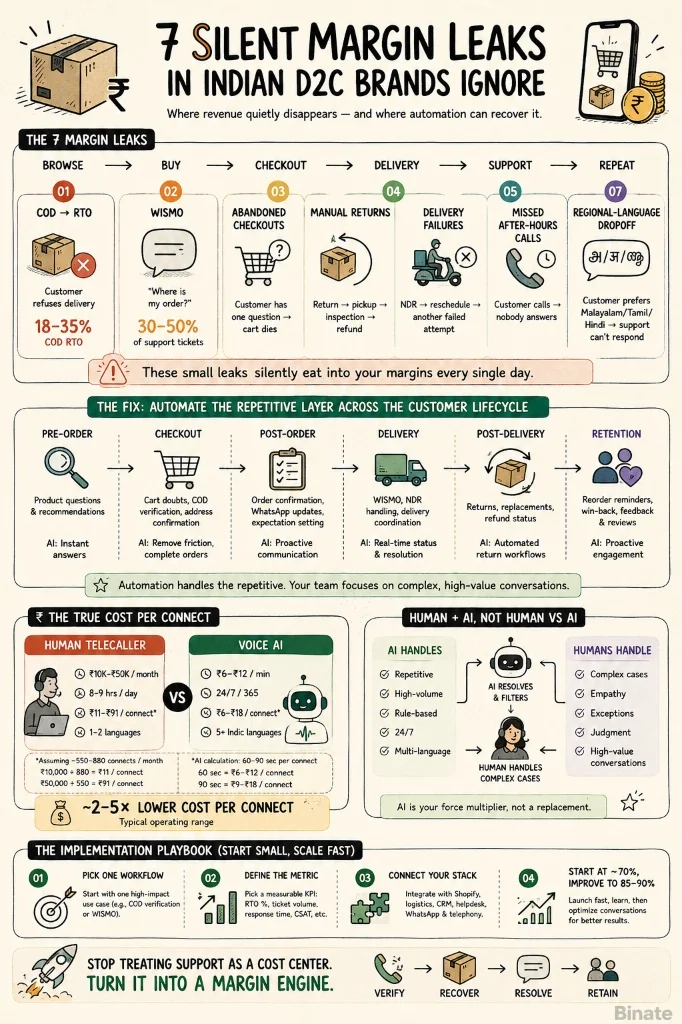
1. RTO: The Cash-on-Delivery Tax
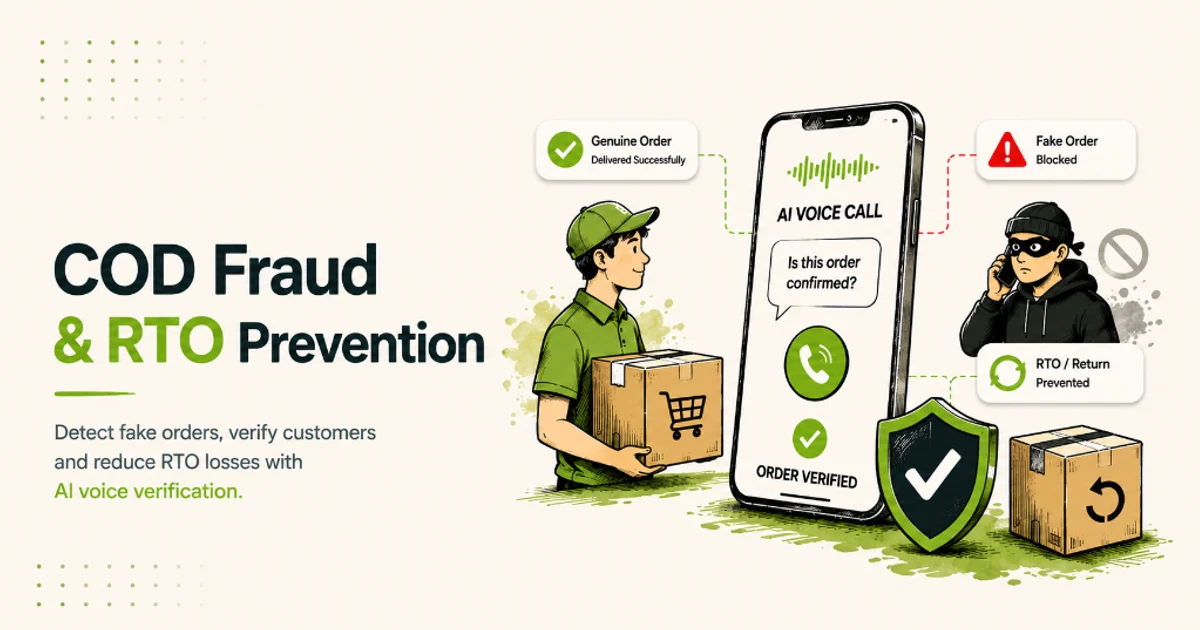
Cash on Delivery still dominates Indian e-commerce. It accounts for 48–62% of all D2C orders, rising to 64–74% in Tier-2 and Tier-3 markets where UPI penetration lags (ShipyBox, 2026). In fashion and apparel, COD hits 58–68% of orders.
The problem: a COD order carries no commitment. The buyer can refuse at the door at zero cost. The national COD RTO rate runs 18–35%, spikes to 25–40% in Tier-2 towns and 32–48% in fashion — while prepaid RTO sits at just 1–4% (GoKwik, 2025; ShipyBox, 2026).
Each returned order costs real money: ₹300–850 covering forward shipping (₹60–120), reverse shipping (₹80–150), repackaging and QC (₹30–80), and the lost customer acquisition cost (₹100–400) (Lokally, 2025). The seller pays twice and earns zero.
2. WISMO: The "Where Is My Order?" Flood
The single largest category of e-commerce support tickets is order status queries. Industry data puts WISMO at 30–50% of all support volume (TRTC, 2026; Metaport, 2026). Every ticket costs ₹150–500 to resolve manually, mostly because agents act as human data bridges between the order system, courier portal, and customer.
None of these tickets requires judgment. Every one of them requires information that already exists. That is the definition of a waste.
3. Abandoned Checkouts
High-intent shoppers drop off at the payment page because they have one question — about sizing, delivery time, or authorization. No one picks up the phone. No one calls back. The cart dies silently.
4. Returns and Exchanges Handled Manually
Every return is a mini-operations project: verify eligibility, generate labels, schedule reverse pickup, inspect, repack, refund. Manual handling burns hours per order and keeps inventory in limbo for days.
5. Delivery Coordination Failures
Failed delivery attempts, NDR (non-delivery report) rescheduling, riders who cannot find the address, customers who need a new time slot. Each failure costs a delivery attempt and pushes the order closer to RTO.
6. After-Hours Missed Calls
Your support team works 9 to 6. Your customers shop at night — especially in India where evening is prime browsing time. Every unanswered call after hours is a sale, a refund request, or a delivery query that turns into a ticket tomorrow morning. Analyze your store's leakage with our missed call revenue calculator.
7. Regional-Language Dropoff
India is not an English-first market. Malayalam, Tamil, Kannada, Hindi, Bengali — millions of buyers think, search, and talk in these languages. Phone support staffed only in English loses these customers at the first "Connecting you to the next available agent." Learn more about regional voice AI for e-commerce.
The Hybrid Model: How the Best Teams Actually Run Support
No serious D2C brand replaces its support team wholesale. The teams that win run a hybrid model: automated agents handle the high-volume, rule-based layer first; human agents take over complex cases with full context.
The principle is simple. AI provides instant response, 24/7 availability, and perfect consistency. Humans provide empathy, judgment, and creative problem-solving. Each plays to its strength — and the customer never repeats their order number twice.
Across the first-touch layer, the data is already conclusive:
- Klarna's AI assistant handles 2.3 million conversations and two-thirds of customer service chats, saving the equivalent of 700 full-time agent salaries.
- Vodafone's AI independently resolves 70% of customer inquiries.
- An Indian logistics workflow provider recovered 30% of failed deliveries by reaching customers within 5 minutes of a delivery failure (Futwork).
- A regional OTT platform achieved 96% containment of repeated case studies in regional languages using multilingual voice agents (Futwork).
What Automation Covers by Lifecycle Stage
| Lifecycle stage | Pain | Automation play | Metric it moves |
|---|---|---|---|
| Pre-order | Product and availability questions | Instant FAQ + product info answering | Conversion rate |
| Checkout | Last-minute hesitation | Abandoned-cart voice check-in | Recovery rate |
| Post-order | COD fraud, fake numbers, unreachable buyers | COD intent + address verification call | RTO rate |
| Post-purchase | WISMO, delivery rescheduling, NDR | Order-status + delivery coordination voice | Ticket volume, CSAT |
| Post-delivery | After-hours support, returns | Returns processing + 24/7 query handling | Support cost, LTV |
| Retention | Silent re-buys, no re-engagement | Post-purchase feedback and reorder calls | Repeat purchase rate |
For a strategic comparison of voice automation options, see Voice AI vs traditional IVR.
The Economics in Rupees: Why Automation Wins
The cost comparison in Western dollars tells half the story. Indian founders need the number in rupees, because that is what hits their balance sheet.
Human Support Economics (2026 India)
| Metric | Human telecaller |
|---|---|
| Fully-loaded monthly cost | ₹30,000 – 70,000 (BPO to in-house senior) |
| Cost per connect | ₹55 – 130 |
| Connects per month | 550 – 880 (80–120 dials/day, 25–40 connects) |
| Availability | 8–9 hours, weekdays only |
| Languages per agent | 1–2 |
| Annual attrition | 35–45% |
| Time to scale 10x | 4–8 weeks of hiring + training |
(MarkAIble, 2026; Caller Digital, 2026; CarmaOne, 2026)
Voice AI Economics (2026 India)
| Metric | Voice AI |
|---|---|
| Per-minute cost | ₹1.50 – 18 (mid-market: ₹4–7/min) |
| Cost per connected call (60–90s) | ₹3 – 8; all-in ~₹10 – 25 by volume tier |
| Availability | 24/7/365 |
| Languages per deployment | 5+ Indic languages natively |
| Consistency | 100% uniform |
| Scale 10x | ~48 hours, no hiring |
| Cost per connect vs human | 2.5 – 5x cheaper |
(Caller Digital, 2026; CarmaOne, 2026; MarkAIble, 2026)
Two numbers matter most. First, voice AI is 2.5–5x cheaper per connect than a human telecaller on the repeatable layer of your volume — before accounting for 24/7 coverage and consistency. Second, effective cost drops ~40% as you scale: from ~₹10 per minute at 25,000 monthly minutes to ~₹6 per minute at 25 lakh minutes (Caller Digital, 2026). Automation is the rare expense that gets cheaper the more you use it.
The India Moat: Speaking the Customer's Language
The multiplier global benchmarks miss is language. A Malayalam-speaking grandmother placing a COD order in Alappuzha, a Tamil storefront owner in Coimbatore, a Hindi-speaking buyer in Tier-2 UP — these customers do not feel comfortable resolving delivery issues in English.
Voice AI built for Indic languages answers in the customer's language natively — Malayalam, Tamil, Kannada, Hindi, Bengali — from day one, not as a bolt-on. For Kerala-focused and South India-first brands, that is not a nice-to-have. It is the difference between a verification call that works and one that gets hung up on. Read how to build regional voice AI.
The Implementation Playbook: Starting Without Breaking Things
Most AI deployments fail not from technology but from ambition. They try to automate the hardest process first and get burned. Here is the sequence that works.
Step 1: Pick One High-Impact Workflow
Choose by four tests:
- Volume — How often does this happen daily? (If it's not daily, it's not a starting point.)
- Cost — What does it cost today in time or money?
- Consistency — Does it follow clear rules?
- Impact — Will automating it move a margin metric you can measure?
For most Indian D2C brands, the best starting point is COD verification or order status inquiries. Both are high-volume, rule-based, and directly tie to RTO and ticket cost — the two biggest leaks above.
Step 2: Define Success Metrics Before Launch
Ambiguous goals produce ambiguous results. Set numbers first:
- Cut RTO by X% within 30 days
- Resolve 60% of WISMO queries without a human
- Reduce average response time from hours to seconds
- Hold support cost per ticket below a target
Track weekly during the first 90 days. Adjust the agent's behavior from the data, not from intuition.
Step 3: Integrate With Your Stack
Consumers of AI agents need real context: order number, items, shipment status, customer history. The agent is only as useful as the systems it reads. Budget real time for integration with your e-commerce platform (Shopify, WooCommerce), logistics (Shiprocket, Delhivery, or a courier aggregator), and CRM (HubSpot). Legacy systems without modern APIs — the "custom middleware" problem — are the most common underestimate in the industry.
Step 4: Expect 70%, Iterate to 85–90%
Day-one accuracy will be roughly 70%. That is normal and fine. Agents improve through feedback: review call logs weekly, fix misrouting, tighten scripts, and watch resolution rates climb to 85–90% within 2–3 months. Do not judge the system on week one.
The Five Mistakes That Cause 90% of Failures
- Starting with complex processes — automating technical support that takes humans six months to learn, instead of starting with order status or appointment basics.
- Not preparing the team — staff who discover they are being "replaced" will resist. Position automation as the removal of boring, repetitive work, not people.
- Expecting perfection on day one — 70% initial accuracy is success, not failure.
- Ignoring integration reality — connecting legacy systems takes longer than vendors claim. Plan for custom work and test thoroughly.
- Choosing features over outcomes — buying a shiny agent instead of solving a specific business problem. Pick the problem first, then the agent.
From Reactive Support to Proactive Revenue Operations
The brands winning the Indian D2C game have stopped asking "how do we handle more tickets" and started asking "how do we eliminate the questions that create them."
Automation turns the support center from a cost center into a revenue operation: it verifies orders before they ship, recovers carts before they die, answers questions the moment they arise, in the customer's own language, at any hour.
The 7 silent costs are not inevitable. They are a design problem — and design problems have solutions.
Frequently Asked Questions
RTO (Return to Origin) happens when a shipped order is rejected or undeliverable and comes back to the seller. For COD orders — which make up 48–62% of Indian D2C volume — the national RTO rate runs 18–35%, spiking to 32–48% in fashion. Each returned order costs ₹300–850 in shipping, repackaging, QC, and lost customer acquisition cost. The seller ships twice and earns zero revenue. Automating a COD intent verification call before dispatch typically cuts RTO by 20–35%.
A voice AI agent calls the customer within minutes of a COD order being placed — before it enters the fulfilment queue. It confirms delivery address, verifies the customer is reachable, and gently assesses purchase intent. Orders with unverified numbers, wrong addresses, or low-intent signals can be flagged for review or converted to prepaid with an incentive. Brands using this workflow have reduced COD RTO by 20–35% within the first 30 days.
WISMO stands for 'Where Is My Order?' — the single largest category of e-commerce support tickets, accounting for 30–50% of all inbound support volume. Every WISMO ticket costs ₹150–500 to resolve manually because support agents act as human bridges between the order system, courier portal, and customer. None of these queries require judgment — they only require information that already exists. A voice or chat automation that reads order status in real time eliminates the entire category without a single human touch.
In 2026, a human telecaller costs ₹55–130 per connect after fully-loaded salary, benefits, and attrition overhead, with availability limited to 8–9 hours on weekdays. Voice AI costs ₹3–8 per connected call (60–90 seconds), or ₹10–25 all-in at mid-market volume tiers — making it 2.5–5x cheaper on the repeatable layer. The cost advantage widens further as volume scales: effective per-minute cost drops roughly 40% from 25,000 to 25 lakh monthly minutes. Voice AI is also available 24/7/365 and speaks 5+ Indic languages from day one.
For most Indian D2C brands, the right starting point is either COD verification or order status (WISMO) — ideally COD verification first. Both are high-volume, fully rule-based, and directly move a margin metric you can measure within 30 days. Avoid starting with complex processes like returns adjudication or technical product support — these require nuanced judgment and are where early AI deployments fail. Win on the simple layer first, then expand.
A focused COD verification or WISMO voice agent typically goes live in 3–7 days when integrated with a standard stack (Shopify or WooCommerce + Shiprocket or Delhivery + HubSpot). The most common delay is legacy system integration — custom middleware or non-API logistics platforms can add 2–4 weeks. Day-one accuracy is typically 70%, improving to 85–90% within 60–90 days of weekly call log reviews and script refinement.
Yes — and this is where India-built voice AI has a structural advantage over generic Western platforms. Multilingual voice agents built for Indian D2C handle conversations natively in Malayalam, Tamil, Kannada, Hindi, and Bengali from day one, not as a translation layer. For COD verification calls in Kerala or Tamil Nadu, a native-language agent has significantly higher pick-up and completion rates than an English-only agent. Regional-language support is not a feature — it is the difference between a call that works and one that gets hung up on.
No. The D2C brands that win use a hybrid model: voice AI handles the high-volume, rule-based first-touch layer (COD verification, WISMO, delivery rescheduling, after-hours queries), while human agents handle complex escalations with full context already captured. This means your team spends less time reading order numbers and more time solving problems that actually require empathy and judgment. Attrition in support teams runs 35–45% annually — automation reduces the pressure to constantly hire and train for repetitive work.
Ready to automate your calls with Binate Voice AI?
Build your AI voice agent free in minutes. Connect your number, test live in Malayalam and English, and go live with zero lock-in.
Get Started Free →