When businesses search for an AI calling agency, they are usually trying to solve the same fundamental problem: get an autonomous voice AI agent live without turning it into a massive, multi-month engineering headache.
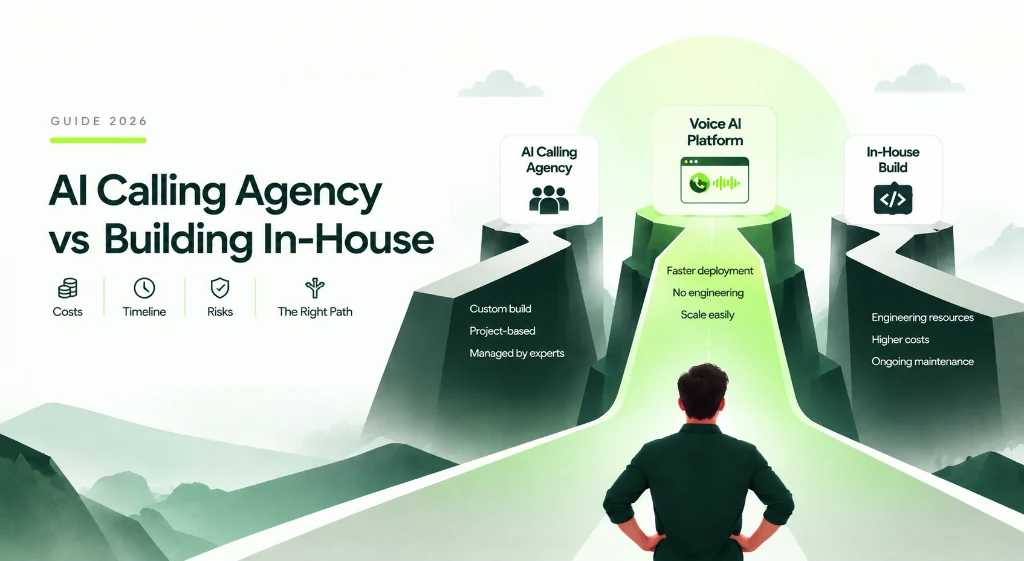
In practice, that search turns up three genuinely different paths, not two:
- Traditional AI Calling Agencies that scope, build, and manage a custom voice bot for you, project-style, with an account team and developer retainer in the loop.
- Self-Serve Voice AI Platforms, where the entire four-layer stack (speech-to-text, reasoning, text-to-speech, telephony) is already built and latency-tuned, and you configure your own agent through a no-code dashboard.
- In-House DIY Builds on raw infrastructure APIs like Twilio, Vapi, or Retell, where your own engineering team assembles, hosts, and maintains every layer.
Each path carries very different costs, timelines, maintenance burdens, and risks - and most engineering teams severely underestimate how much ongoing work the DIY path actually requires in production.
This guide breaks down the true anatomy of a production voice AI stack, where in-house builds quietly fail, and how to choose the right route for your business.
The True Anatomy of a Production Voice AI Stack
An AI voice calling agent is not a single software product. It is four separate, high-speed distributed systems wired together and tuned to operate as one continuous, real-time conversation:
Caller Audio ──▶ [ 1. Speech-to-Text (STT) ]
                       │ (Transcript Stream)
                       ▼
                 [ 2. Contextual LLM Reasoning ]
                       │ (Token Stream)
                       ▼
                 [ 3. Text-to-Speech (TTS) ]
                       │ (Audio Chunks)
                       ▼
Caller Ear   ◀── [ 4. SIP Trunking / Telephony ]
1. Speech-to-Text (STT) Layer
Converts the caller's spoken audio into text in real time. This is where accent handling, background noise filtering, and code-switched speech (such as a caller sliding between English and Malayalam mid-sentence, commonly known as Manglish) either work smoothly or fall apart. In India, acoustic models must also handle variable 3G/4G audio packet loss without hallucinating syllables.
2. LLM Reasoning Layer
The conversational "brain" that determines what to say next. It pulls context from your CRM, inventory database, or Google Calendar, handles objections, and dynamically navigates unstructured dialogue instead of reading from a rigid script.
3. Text-to-Speech (TTS) Layer
Transforms generated text back into a natural, expressive human voice. To avoid sounding like a robotic telemarketer, the TTS engine must support localized phonetic pacing, natural breath pauses, and regional inflection rather than flat Western cadences.
4. SIP Trunking & Telephony Layer
The telecommunications infrastructure that handles carrier-level routing, number provisioning, call recording, DTMF fallbacks, and real-time audio streaming over WebSockets.
Each of these four layers has its own latency, its own unique failure modes, and its own vendor API. A voice AI assistant only feels natural when all four are synchronized end-to-end for the specific accents and phone networks your callers actually use.
The 3 Hidden Traps of In-House Builds
On paper, stitching together Twilio for telephony, an open-source or API-based STT/TTS pair, and an LLM for reasoning looks straightforward. A capable engineering team can easily get a working proof-of-concept running on a laptop in a couple of weeks.
The serious problems show up after launch, once the agent handles real customer calls over live Indian cellular networks.
1. Latency Spikes Past 1.5 Seconds (The Conversation Killer)
Each layer in the stack introduces its own latency budget:
- Speech recognition endpointing: 250-400ms
- LLM time-to-first-token (TTFT): 300-600ms
- Text-to-speech generation: 200-350ms
- Telephony network transit: 150-250ms
When chained together under real-world conditions on Indian mobile networks (Jio, Airtel, Vi), round-trip response latency frequently creeps past 1,500ms (1.5 seconds).
To a caller, anything beyond 800ms feels sluggish; past 1.5 seconds, the conversation feels awkward and broken, causing callers to talk over the bot or simply hang up. Achieving sub-800ms conversational turn-taking requires sophisticated custom streaming, speculative execution, and aggressive audio buffer management - not just basic API chaining.
For a deeper look into the engineering behind sub-second regional voice models, read How We Built Malayalam Voice AI Infrastructure.
2. Hallucinated Booking Slots & Broken Data Sync
Large Language Models sound exceptionally confident even when they are factually wrong. Without deterministic guardrails and atomic calendar locking, an in-house agent can confidently offer appointment slots that are already booked, misinterpret date formats, or fail to write customer details back to your CRM.
In a demo, an unconfirmed booking is a minor bug. In a busy clinic, hospital, or real estate agency, it means angry customers arriving for appointments that do not exist.
3. Continuous Engineering Maintenance Overhead
A voice AI pipeline is never "build once and forget."
- STT and TTS providers frequently update acoustic models, altering phonetic recognition.
- LLM providers deprecate model checkpoints, change pricing tiers, or adjust system prompt behaviors.
- Telecom carriers update SIP routing rules and spam filtering thresholds.
In-house engineering teams often discover six months post-launch that "maintaining the voice bot" has quietly morphed into a full-time support job for a senior developer who was hired to build core product features.
Building in-house does not just cost developer salaries during initial development; it consumes 10-15 hours of ongoing engineering maintenance every week to manage model deprecations, latency spikes, and API changes.
Comparing the Three Deployment Paths
To make the right operational decision, compare the Total Cost of Ownership (TCO), timeline, and technical overhead across all three options:
| Evaluation Criteria | Traditional AI Agency | In-House DIY Build | Self-Serve Voice AI Platform |
|---|---|---|---|
| Time to Live | 4-8 weeks (scoping & development) | 2-4 months (build & tune) | Under 10 minutes |
| Initial Setup Cost | Rs. 50,000 - Rs. 2,50,000+ project fee | Rs. 2,00,000+ in dev hours | Rs. 0 (Free to build & test) |
| Ongoing Monthly Cost | Rs. 25,000 - Rs. 75,000 retainer | Developer maintenance salaries | From Rs. 9/min or Rs. 9,000/mo |
| Engineering Burden | Low (Agency handles dev) | Very High (100% on your team) | Zero (No-code dashboard) |
| Regional Language Tuning | Variable (often basic translation) | Difficult (custom ML tuning) | Native Malayalam, English & Hindi |
| Telephony & DLT Compliance | Managed manually | You must manage TRAI/DLT | Built-in automated compliance |
| Control & Agility | Slow (requires change requests) | High (direct code access) | Instant (edit prompts anytime) |
Deep Dive: What Each Option Gives You
Path 1: The Traditional AI Calling Agency
You hand off your business requirements to an external agency team who scopes, codes, and manages a custom voice agent for you on their own infrastructure or your cloud account.
- When it makes sense: Genuinely bespoke enterprise use cases with legacy on-premise PBX phone systems, highly complex multi-system ERP integrations, or when you require white-glove account managers to oversee daily campaign scripts.
- The Trade-off: High upfront setup fees, multi-week scoping cycles, and ongoing retainer costs. If you want to update a single qualification question in your call flow, you usually have to submit a ticket to the agency.
Path 2: In-House DIY Build
Your internal engineering team licenses raw developer APIs (Twilio, Vapi, Retell, Deepgram, OpenAI) and writes the orchestration glue, webhook routing, and CRM sync from scratch.
- When it makes sense: When Voice AI is the primary core intellectual property of your software product, and you are prepared to hire dedicated ML/telephony engineers to maintain and monitor the pipeline 24/7.
- The Trade-off: High engineering opportunity cost, unpredictable cloud API bills, and the ongoing burden of debugging telecom packet loss, accent misclassifications, and latency creep.
Path 3: Self-Serve Voice AI Platform
The complete four-layer stack is already engineered, optimized for low latency, and pre-trained on Indian accents and vernacular languages. Business owners or marketing teams configure agent personas, connect existing phone numbers, and set up CRM workflows via an intuitive no-code interface.
- When it makes sense: For 90% of businesses that need an agent to answer inbound calls, qualify outbound paid ad leads, verify e-commerce orders, or book appointments reliably - live in minutes with zero engineering overhead.
Where Binate Fits: A Self-Serve Voice AI Platform
Binate is built as a self-serve platform, not a high-friction agency.
You do not need to schedule weeks of scoping calls or sign long-term lock-in contracts. You configure your voice agent directly in a visual dashboard, customize conversation flows in Malayalam and English, connect your phone number or CRM, and go live immediately.
1. Create Persona  ──▶  2. Connect Number  ──▶  3. Test Live Call  ──▶  4. Go Live
   (Set prompt & flows)      (Use your existing line)    (On your mobile phone)     (Instant deployment)
Transparent, Value-Driven Pricing:
- Pay As You Go: Rs. 9/minute - Build and test free. Recharge Rs. 3,000 into your wallet to go live with zero monthly lock-in.
- Starter Plan: Rs. 9,000/month - 1,500 calling minutes included, one custom workflow, Malayalam + English support.
- Growth Plan: Rs. 18,000/month - 3,500 calling minutes included, WhatsApp integration, priority support, and multi-workflow automation.
- Enterprise: Custom volume pricing for multi-location hospitals, real estate builders, dedicated number pools, and custom API webhooks.
Instead of paying Rs. 2,00,000+ in developer salaries or agency retainers, you deploy a production-ready voice agent tuned for Indian callers at a fraction of the cost.
To see the economic impact of unanswered calls on your business, calculate your numbers with our Missed-Call Revenue Loss Calculator.
Which Path Should You Choose?
- If you have a dedicated engineering team building a proprietary voice product: Build In-House.
- If you have a massive legacy enterprise PBX requiring custom on-site consulting: Hire a Traditional Agency.
- If you want a reliable, accent-fluent voice agent live on your phone number today: Choose a Self-Serve Voice AI Platform.
For a detailed walkthrough on how autonomous calling agents compare to older telephone automation systems, explore our guide on Voice AI vs. Traditional IVR.
Deploy your AI voice agent in under 10 minutes
Build your custom inbound or outbound calling agent free. Connect your number, test live in Malayalam and English on your own mobile phone, and go live with zero lock-in.
Get Started Free →Frequently Asked Questions
An AI calling agency is a service firm that scopes, writes custom code, and manages voice bots on a project or retainer basis. A voice AI platform like Binate is self-serve software where the underlying speech recognition, AI reasoning, and telephony infrastructure are already built and latency-tuned. Platforms allow businesses to build, test, and launch their own voice agents in minutes via a dashboard with zero coding.
Building a basic prototype in-house using raw APIs (like Twilio, OpenAI, and Deepgram) typically requires 150-300 engineering hours (Rs. 1.5L-Rs. 3L in developer time). However, ongoing maintenance, model update fixes, SIP trunking monitoring, and latency optimization typically cost an additional Rs. 30,000-Rs. 60,000 monthly in engineering time and third-party API bills.
A voice bot must chain Speech-to-Text, LLM token generation, and Text-to-Speech sequentially. Over standard Indian 4G/5G mobile networks, unoptimized API chaining introduces 1.5 to 2.5 seconds of round-trip delay. Specialized voice platforms solve this by using streaming audio WebSockets, custom voice endpointing, and speculative LLM token generation to keep conversational latency under 800ms.
Yes. Modern self-serve platforms connect directly via webhooks and REST APIs to popular CRMs (Zoho, HubSpot, LeadSquared), Google Calendar, and custom internal databases, allowing automated lead qualification, contact creation, and live appointment booking during calls.
You can build and test an AI voice agent on Binate in under 10 minutes without writing a single line of code. Simply select your language (Malayalam, English, or mixed), configure your business persona, and test a live incoming call directly on your mobile phone.