Small business owners often sign up for traditional virtual answering services with high hopes.
The sales pitch sounds ideal: instead of paying a full-time in-house receptionist ₹25,000 to ₹35,000/month, you pay an outsourced call center ₹15,000/month to answer your phones when you are busy.
Then the first month's invoice arrives.
Instead of ₹15,000, the bill is ₹45,000+. Why? Because traditional answering services bill by the minute—and they charge full per-minute rates for robocallers, telemarketers, wrong numbers, and callers placed on hold while the operator reads a generic script.
In 2026, business phone management has entered a major transition. Conversational Voice AI has matured beyond robotic touch-tone menus, giving businesses a true third choice between expensive human call centers and missed customer calls.
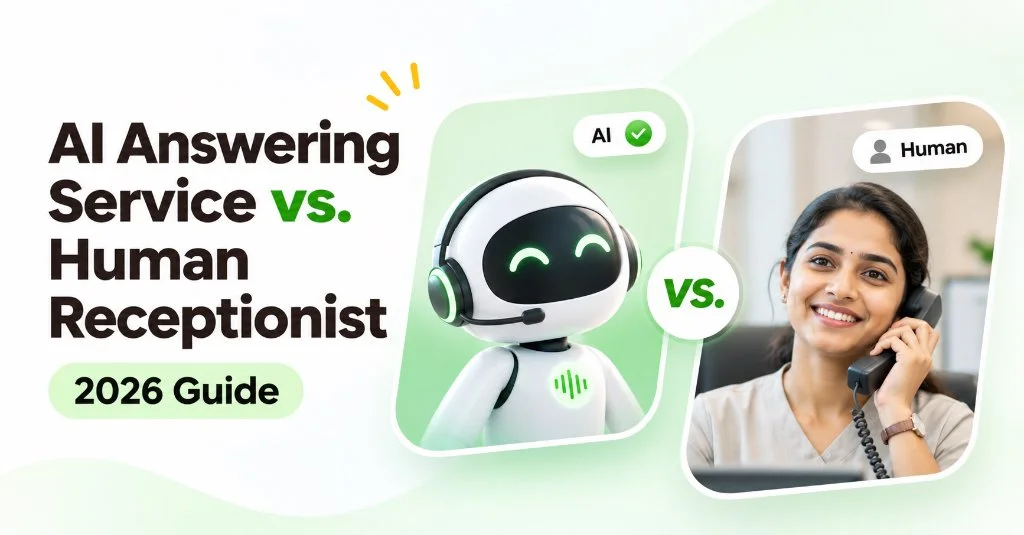
This guide provides a comprehensive, transparent comparison between AI answering services, legacy live virtual receptionists (Ruby, AnswerConnect, Smith.ai), and in-house front-desk staff, evaluating real pricing models, response latency, multi-call concurrency, and software integrations.
Want to hear how modern Voice AI handles calls?
You can test a live conversation with an AI receptionist directly in your browser using the Binate Interactive Demo in under 30 seconds.
The Three Front-Desk Models in 2026
When evaluating how to manage incoming customer inquiries, businesses typically choose between three distinct operating models:
1. In-House Human Receptionist
- How it works: A full-time or part-time employee sits at your physical front desk or works remotely dedicated strictly to your business.
- The Strengths: Deep emotional empathy, physical presence for walk-in visitors, and intimate knowledge of your specific team dynamics.
- The Limitations: Single-call capacity (if two calls ring at once, one is placed on hold or dropped), limited to 8-hour daily shifts (leaving 128 hours of the week uncovered), and high fixed overhead (salary, payroll taxes, benefits, desk equipment).
2. Live Virtual Receptionist Services (Ruby, AnswerConnect, Abby Connect)
- How it works: You forward your phone lines to a shared pool of remote call-center agents who answer using your business name and follow a basic written script.
- The Strengths: Professional human voice, zero employee management overhead, and flexible call-forwarding schedules.
- The Limitations: Expensive per-minute pricing (₹150 to ₹250+ per minute), lack of deep technical integration into your CRM or calendar, hold queues during peak call hours, and operators who often lack context when callers ask detailed questions.
3. Autonomous AI Voice Agents
- How it works: A conversational Voice AI agent answers your published phone line instantly on the first ring, understands spoken inquiries in natural language, checks real-time database availability, books calendar appointments, and syncs summaries directly to your CRM.
- The Strengths: Infinite simultaneous call concurrency (zero busy signals), true 24/7/365 coverage, sub-400ms conversational response times, deep bi-directional software integrations, and 80%+ lower operational costs.
- The Limitations: Best suited for qualification, appointment booking, and routine customer service; complex high-stakes negotiations or nuanced emotional disputes still require escalation to human staff.
Head-to-Head Comparison Matrix
The table below summarizes the operational and financial differences across all three approaches:
| Operational Metric | In-House Staff | Traditional Virtual Answering (Ruby / AnswerConnect) | Modern AI Answering Service (Binate) |
|---|---|---|---|
| Typical Monthly Cost | ₹25,000 – ₹40,000/mo (Full-time salary) | ₹25,000 – ₹95,000+/mo (Billed per minute + retainers) | Predictable flat tiers (from ₹9,000/mo or sub-₹6/min) |
| Answer Speed | 2 to 4 rings (or busy signal) | 3 to 6 rings (frequently queued) | Immediate (1st ring / sub-400ms response) |
| Simultaneous Concurrency | 1 call at a time | 2–3 pooled operators (queues form during rushes) | Unlimited concurrent lines (0 dropped calls) |
| Spam & Robocall Billing | Free (wastes staff time) | Full per-minute charge (major hidden cost) | Zero cost (filtered instantly) |
| Calendar Scheduling | Manual Google/Outlook booking | Limited (often takes a callback message) | Native two-way real-time calendar booking |
| CRM Integration | Manual rep data entry | Basic email or Zapier message notification | Automated bi-directional sync (HubSpot, Salesforce) |
| After-Hours & Weekends | None (requires overtime or 2nd shift) | Expensive weekend & holiday surcharges | Standard 24/7/365 coverage included |
| Multilingual Support | Rare (requires specialized hiring) | Extra fee per bilingual agent | Native multilingual auto-detection & code-switching |
The Hidden "Spam Tax" of Traditional Virtual Answering Services
The most common complaint from business owners using legacy answering services is the per-minute pricing model.
Traditional answering services bill in 30-second or 60-second rounded blocks. If a robocaller dials your number and stays on the line for 22 seconds before hanging up, you are billed for a full minute at ₹150 to ₹250.
The Real Math of a "100-Minute" Plan:
  - 40 Genuine Customer Calls (Avg. 2.5 mins)    = 100 Minutes
  - 25 Telemarketers / Robocalls (Billed 1 min)   = 25 Minutes
  - 15 Wrong Numbers / Hang-ups (Billed 1 min)    = 15 Minutes
  ─────────────────────────────────────────────────────────────
  Total Minutes Billed: 140 Minutes
  Base Plan (100 Mins):   ₹20,000
  Overage (40 Mins @ ₹200/min): +₹8,000
  Total Monthly Bill:     ₹28,000 (₹700 per actual customer call!)
With an AI answering service, robocalls and wrong numbers are identified by conversational intent within seconds and dropped automatically—costing virtually nothing.
Every minute you pay for is spent on genuine customer interactions, appointment bookings, and lead qualifications.
Market Alternatives Compared: Ruby vs. AnswerConnect vs. Smith.ai vs. Voice AI
1. Ruby Receptionists
Ruby is one of the most recognized live virtual receptionist services in North America. Their US-based operators are exceptionally cheerful and maintain high conversational etiquette.
- Pricing: Tiered packages starting around ₹20,000/month for just 50 minutes (~₹400 per minute). Heavy per-minute overages apply once you exceed your allotment.
- Best For: Boutique law firms or medical executives with very low call volumes who want a white-glove human voice to take callback messages.
- Limitations: Cost becomes prohibitive as call volume scales; cannot hold multi-turn technical dialogues or perform complex database updates.
2. AnswerConnect
AnswerConnect offers 24/7 live answering powered by distributed global teams, making them more accessible for night and weekend coverage than regional boutique services.
- Pricing: Bundled minute plans starting around ₹28,000 to ₹55,000/month.
- Best For: Home service contractors (plumbers, HVAC, electricians) who need emergency call routing outside of standard 9-to-5 hours.
- Limitations: Callers often notice varying operator accents; callers frequently report that operators simply "take a message" rather than solving the problem on the spot.
3. Smith.ai
Smith.ai is a hybrid service that blends human call-center agents with automated routing algorithms, making them more tech-forward than traditional call centers.
- Pricing: Per-call pricing models (starting around ₹25,000/month for 30 calls = ~₹800 per call), or per-minute hybrid tiers.
- Best For: Small law practices and financial consultancies that require preliminary intake qualification and conflict-of-interest checks.
- Limitations: High per-call cost; while they integrate with many legal CRMs (Clio, LawPay), customization options remain locked within their proprietary platform.
4. Autonomous Voice AI (Binate)
Binate replaces shared human call centers with dedicated, sub-400ms conversational AI voice agents configured specifically for your business.
- Pricing: Transparent pay-as-you-go starting at predictable monthly tiers (from ₹9,000/month or sub-₹6/minute), with zero per-minute penalties for spam or call volume spikes.
- Best For: Growing small businesses, healthcare clinics, e-commerce brands, real estate firms, and service agencies that receive 150 to 5,000+ calls per month.
- Key Advantages: Instant zero-ring pickup, infinite call concurrency, native multilingual capabilities (fluent English, Malayalam, Tamil, Hindi), and direct bi-directional calendar and CRM synchronization.
Where Human Receptionists Still Excel (The Honest Perspective)
Conversational AI has evolved rapidly, but it is not intended to replace human empathy across every touchpoint.
A high-performing human receptionist remains superior in several critical business contexts:
- In-Person Hospitality: An AI cannot greet visitors walking into a dental lobby, offer a cup of coffee, or validate parking tickets.
- Acute Emotional Crises: In hospice care, grief counseling, or high-stakes criminal defense, callers are in extreme distress. They need emotional co-regulation from a human before discussing logistics.
- Complex Non-Standard Problem Solving: When a scenario breaks all documented business rules, a human can exercise lateral thinking and personal discretion.
The Winning Strategy: The Hybrid Desk
The most profitable businesses don't choose between human staff and AI; they combine them:
- The Human Front Desk: Focuses 100% on greeting walk-in clients, building client relationships, and closing complex transactions without the distraction of a constantly ringing telephone.
- The AI Voice Agent: Operates silently in the background, picking up second and third incoming lines, answering calls after 6:00 PM, scheduling appointments on the calendar, and screening out 100% of cold spam callers.
Buyer's Checklist: How to Choose the Right Solution
Use this quick framework to determine which solution fits your current operational stage:
Do you receive fewer than 40 calls per month?
  ├── YES ──▶ Keep your mobile phone or a basic virtual answering service.
  └── NO  ──▼
Do you receive frequent simultaneous calls during peak hours?
  ├── YES ──▶ Deploy an AI Answering Service (eliminates hold times & missed calls).
  └── NO  ──▼
Do you lose qualified customer bookings after 6:00 PM or on weekends?
  ├── YES ──▶ AI Answering Service (provides 24/7 calendar booking at zero overtime cost).
  └── NO  ──▼
Does your front desk spend 3+ hours daily answering the same 5 basic questions?
  └── YES ──▶ AI Answering Service (frees your staff for high-value work).
Frequently Asked Questions
Yes. Unlike traditional call centers that merely take a callback note, an AI voice agent connects directly to Google Calendar, Cal.com, Outlook, or your CRM. It checks live availability in real time, offers open slots, books the booking, and sends an immediate calendar invite.
Modern conversational AI operates with sub-400ms latency, natural conversational pauses, and realistic voice cadence. Most callers care primarily about getting their questions answered and appointments booked instantly without waiting on hold.
You configure explicit escalation guardrails. If a caller requests a human manager, describes an urgent emergency, or mentions high-priority keywords, the AI executes an immediate warm SIP transfer directly to your designated mobile phone.
Yes. You do not need to change or port your published business phone number. You simply set up conditional call forwarding on your carrier line so unanswered calls, busy signals, or after-hours rings route to the AI agent automatically.
Stop Paying Per-Minute Answering Service Overages
Upgrade to a 24/7 AI answering service that answers on the first ring, books appointments, and syncs directly with your CRM.
Try the Free Live Demo →