If you run sales, support, or collections for an Indian business, you already know the uncomfortable truth: most of your leads are gone before anyone calls them. Every day, ad spend generates fresh inbound interest - and every day, a chunk of it goes cold in the queue.
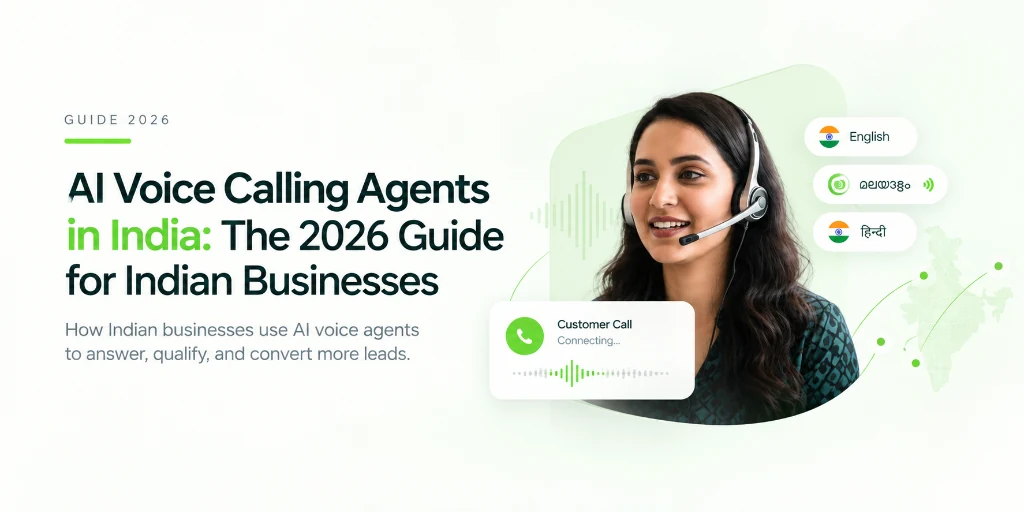
This is where AI calling agents in India have moved from novelty to necessity. Unlike the generic voice bots exported from US and European platforms, a new generation of India-built calling agents is solving for the things that actually matter here: accents, background noise, code-switching between Malayalam, Hindi, English, and regional languages, and telecom latency across Jio, Airtel, and Vi networks.
This guide breaks down what an AI voice calling agent actually does, why the "import a US bot" approach fails in the Indian market, and how to think about the economics, compliance, and rollout of an autonomous calling agent for your business.
The Speed-to-Lead Crisis in India
Here is the number that should worry every sales leader running paid ads in India: an estimated 70% of leads from paid campaigns go cold before a human sales agent ever dials them.
Why does this happen so consistently?
- Lead volume outpaces telecaller capacity. A single Meta or Google campaign can generate hundreds of form-fills an hour; a telecalling team dials in batches, often hours later.
- Time-of-day mismatches. Leads come in throughout the day and night; human teams work shifts, lunch breaks, and have finite headcount.
- Manual CRM handoffs. Leads sit in a spreadsheet or CRM view waiting to be assigned before anyone even attempts contact.
- The "golden window" is brutally short. Landmark research published in the Harvard Business Review on online sales leads demonstrated that businesses attempting contact within 5 minutes are nearly 100 times more likely to connect and qualify a lead than those waiting 30 minutes. In India's fast-moving digital economy, waiting even an hour means your prospect has already called a competitor.
As we explore in our analysis of why 78% of customers never call back, modern consumers do not wait for follow-ups; they move on to the first provider who actually picks up the phone.
An AI calling agent closes this gap by dialing a lead within seconds of form submission - no queue, no shift schedule, no "I'll call you back after lunch." For a business paying Rs. 500-Rs. 2,000 per lead on ads, that speed advantage alone often pays for the entire AI calling stack.
Harvard Business Review data shows that contacting a prospect within 5 minutes produces up to a 9x to 21x increase in lead qualification rates compared to waiting 30+ minutes. Autonomous voice AI bridges this latency gap entirely.
Inbound vs. Outbound AI Calling: Two Different Jobs
"AI calling bot" gets used as a catch-all term, but inbound and outbound calling agents solve different problems and should be evaluated separately.
1. Inbound AI Voice Agents (24/7 Zero-Hold Front Desk)
Inbound voice agents answer calls instantly on the first ring - no hold music, no "please stay on the line," no missed calls after 6 PM. They handle complex customer inquiries, schedule appointments directly into calendars, route emergency calls to on-duty specialists, and log conversation transcripts into CRMs like Zoho, LeadSquared, or HubSpot.
For appointment-heavy sectors like clinics, diagnostic labs, and educational institutions, automated front-desk scheduling captures high-intent revenue that is otherwise lost during peak reception rushes. See how this operates in practice with our guide to 24/7 AI appointment booking for clinics and healthcare.
2. Outbound AI Calling Agents (Instant Speed-to-Lead Qualification)
Outbound calling agents are engineered for speed-to-lead: the instant a prospect submits a lead form on Meta, Google, or a website landing page, an API trigger instructs the AI agent to dial the prospect within 15 seconds.
The agent greets the prospect in their preferred language, verifies intent, asks qualifying questions (budget, timeline, service requirements), and either books a scheduled calendar demo or initiates a live warm-transfer to a human sales closer.
Most mature businesses run both: an inbound agent that never misses a ringing line, and an outbound agent that never lets a paid ad lead go cold.
For a deeper architectural comparison on why conversational AI has made keypad menus obsolete, see our breakdown of Voice AI vs. Traditional IVR.
The Regional Language Factor: Why Generic Bots Fail in India
This is the single biggest reason off-the-shelf, US-built voice AI platforms underperform in the Indian market.
Indian conversations rarely happen in "pure" English or textbook Malayalam/Tamil/Hindi. A real call might open in English, switch into Malayalam mid-sentence, and incorporate colloquial phrases when the caller gets comfortable. Generic bots trained on Western datasets struggle with this code-switching; they pause, trigger translation lag, or respond in the wrong language, resulting in immediate call drop-offs.
An AI calling agent built for the Indian market must natively handle:
- Code-switched speech - Seamlessly parsing Malayalam-English (Manglish), Hinglish, and regional blends without treating each switch as an external translation event.
- Regional accent variation - Accurately understanding phonetic variations from callers across Kerala, Tamil Nadu, Karnataka, and North Indian hubs.
- Background noise tolerance - Filtering out ambient street sounds, honking, shop machinery, and two-wheeler noise common on Indian mobile connections.
- Sub-800ms low latency over Indian networks - Operating with conversational turn-taking speed across Jio, Airtel, and Vi networks so the interaction feels natural.
Real Deployment Benchmarks & Case Studies
When voice models are trained on real Indian telephone conditions, the performance gap between generic bots and localized AI agents becomes clear:
- 96.6% Call Completion Rate: While traditional robotic IVRs suffer 40-50% drop-off rates due to menu fatigue, Binate's localized voice architecture achieves an average 96.6% call completion rate on live production calls.
- Coaching Institute in Thrissur: Prior to deploying voice AI, over 42% of inbound admission queries went unanswered during peak evening hours (6 PM - 10 PM). By deploying a Malayalam-fluent AI agent, the academy automated 100% of after-hours intake, scheduling 140+ verified parent visits in its first month.
- Specialty Clinic in Kothamangalam: Reception staff were overwhelmed during morning outpatient rushes, causing patients to abandon appointment calls. An inbound AI receptionist answered calls on the first ring, handling doctor slot bookings and cutting receptionist phone workload by 65%.
- Regional E-commerce COD Verification: In D2C campaigns across South India, vernacular voice agents verifying Cash-on-Delivery orders in native regional languages achieve 85%+ verification completion rates, compared to just 48% for standard robotic English IVR dialers.
To read about how Binate built this infrastructure from the ground up, see: How We Built Malayalam Voice AI Infrastructure.
Unit Economics: AI Calling Agent vs. Human Telecalling Team
The financial case for deploying autonomous AI calling agents in India centers on fixed operational overhead versus scalable per-minute compute costs.
Human Telecalling Team
| Cost & Operational Factor | Typical Human Telecalling Baseline |
|---|---|
| Per-agent monthly salary | Rs. 20,000 - Rs. 25,000 / month |
| Management, QA & Team Lead overhead | +20% to 30% added cost per seat |
| Annual attrition & rehiring rate | 40% - 60% average turnover across Indian BPOs |
| Operational coverage | 8-hour shifts (No nights, Sundays, or holidays) |
| Concurrent call capacity | Exactly 1 call per active agent |
| Script adherence & mood consistency | Variable (affected by fatigue and call volume) |
Autonomous AI Voice Calling Agent
| Cost & Operational Factor | Binate AI Calling Agent Benchmark |
|---|---|
| Per-call operational cost | Rs. 3 - Rs. 9 per completed call |
| Fixed monthly seat license / salary | Rs. 0 fixed payroll overhead |
| Operational coverage | 24/7/365 (Zero downtime during festival rushes) |
| Concurrent call capacity | Hundreds of simultaneous calls instantly |
| Script adherence & qualification accuracy | 100% consistent logic on every call |
| Attrition, recruitment & training cost | Zero attrition / instant deployment |
Consider a business generating 3,000 leads per month: maintaining a team of 5 full-time telecallers costs Rs. 1,00,000 - Rs. 1,30,000 monthly in payroll and supervision, yet still faces delayed callback times during peak hours. An AI calling agent can qualify those same 3,000 leads within 30 seconds of submission at a fraction of that expenditure.
The AI agent does not replace your top-tier sales closers; it frees them from repetitive qualification dials so they can focus entirely on closing warm, verified prospects.
Calculate the exact monthly revenue your business loses to uncalled leads and after-hours missed calls using our free interactive tool.
To run the calculation for your specific industry, use the Missed-Call Revenue Loss Calculator.
Indian Compliance and Best Practices: TRAI, DND, and DLT
Deploying an AI calling agent in India is not merely an engineering decision - it is a regulatory one governed by the Telecom Regulatory Authority of India (TRAI). With stricter guidelines targeting unsolicited robo-calling, compliance must be architected from day one.
Key regulatory standards to adhere to:
- Telemarketer Registration: Commercial entities initiating voice outreach must hold valid registration under the TRAI Telecom Commercial Communications Customer Preference Regulations (TCCCPR, 2018).
- DND & NCPR Scrubbing: Before launching promotional outbound campaigns, all contact lists must be automatically scrubbed against the TRAI National Customer Preference Register (NCPR) to prevent unsolicited calling to registered DND numbers.
- DLT Integration & Header Binding: Outbound systems should integrate with telecom Distributed Ledger Technology (DLT) portals for transparent sender ID registration, template verification, and cryptographic call logging.
- Purpose & Sender ID Separation: Maintain strict separation between transactional/service communications (appointment reminders, delivery updates) and promotional sales campaigns.
- Consent-First Lead Generation: The safest, highest-converting practice is to trigger automated outbound calls strictly to warm opt-in prospects (users who submitted a form, requested a callback, or messaged via WhatsApp) rather than dialing cold scraped databases.
TRAI's ongoing enforcement has deployed AI-driven spam analytics across telecom networks to flag unregistered telemarketing. Working with a compliant Voice AI infrastructure partner ensures automated DND scrubbing, DLT logging, and zero compliance penalties.
What Losing the Speed-to-Lead Race Is Costing Your Business
Every lead that goes cold before someone dials back represents marketing ad budget walking directly to your competitors. Before determining whether voice automation fits your pipeline, quantify your team's current response gap.
Our cornerstone research on The Real Cost of Missed Calls for Indian Businesses provides full 2026 industry benchmarks across healthcare, education, D2C, and real estate - and the Missed-Call Revenue Calculator lets you compute your monthly revenue recovery potential in minutes.
Prefer to start on your own?
Build your AI voice agent free in minutes on Binate's self-serve platform. Connect your number, test live in Malayalam and English, and go live with zero lock-in.
Get Started Free →Frequently Asked Questions
An AI voice calling agent is an autonomous conversational system that understands natural spoken language, reasons contextually, and executes live tasks like scheduling appointments, qualifying buyer intent, and updating CRMs. In contrast, traditional IVR (Interactive Voice Response) systems rely on pre-recorded audio prompts and keypad inputs (e.g., 'Press 1 for sales'), creating rigid menus that lead to high customer drop-off.
Yes, provided it is built with regional language acoustic models. Binate's AI calling infrastructure is trained natively for regional Indian speech patterns, effortlessly handling code-switching between Malayalam, English (Manglish), and regional dialects, while filtering out ambient background noise.
Yes, when conducted in full compliance with TRAI's TCCCPR (2018) regulations. Businesses must operate via registered telemarketer headers, scrub promotional lists against the NCPR/DND registry, and sync logs with telecom DLT platforms. Binate's platform incorporates automated DND scrubbing and compliance workflows natively.
A human telecaller in India costs approximately Rs. 20,000 to Rs. 25,000 monthly in base salary, plus recruitment, QA overhead, and management costs. An AI calling agent operates at roughly Rs. 3 to Rs. 9 per completed call with zero fixed salaries, 24/7 availability, and the ability to scale to hundreds of concurrent calls without additional hiring.
A standard managed deployment for inbound customer reception or outbound lead qualification can be configured, integrated with your CRM, and deployed live within 48 to 72 hours.